
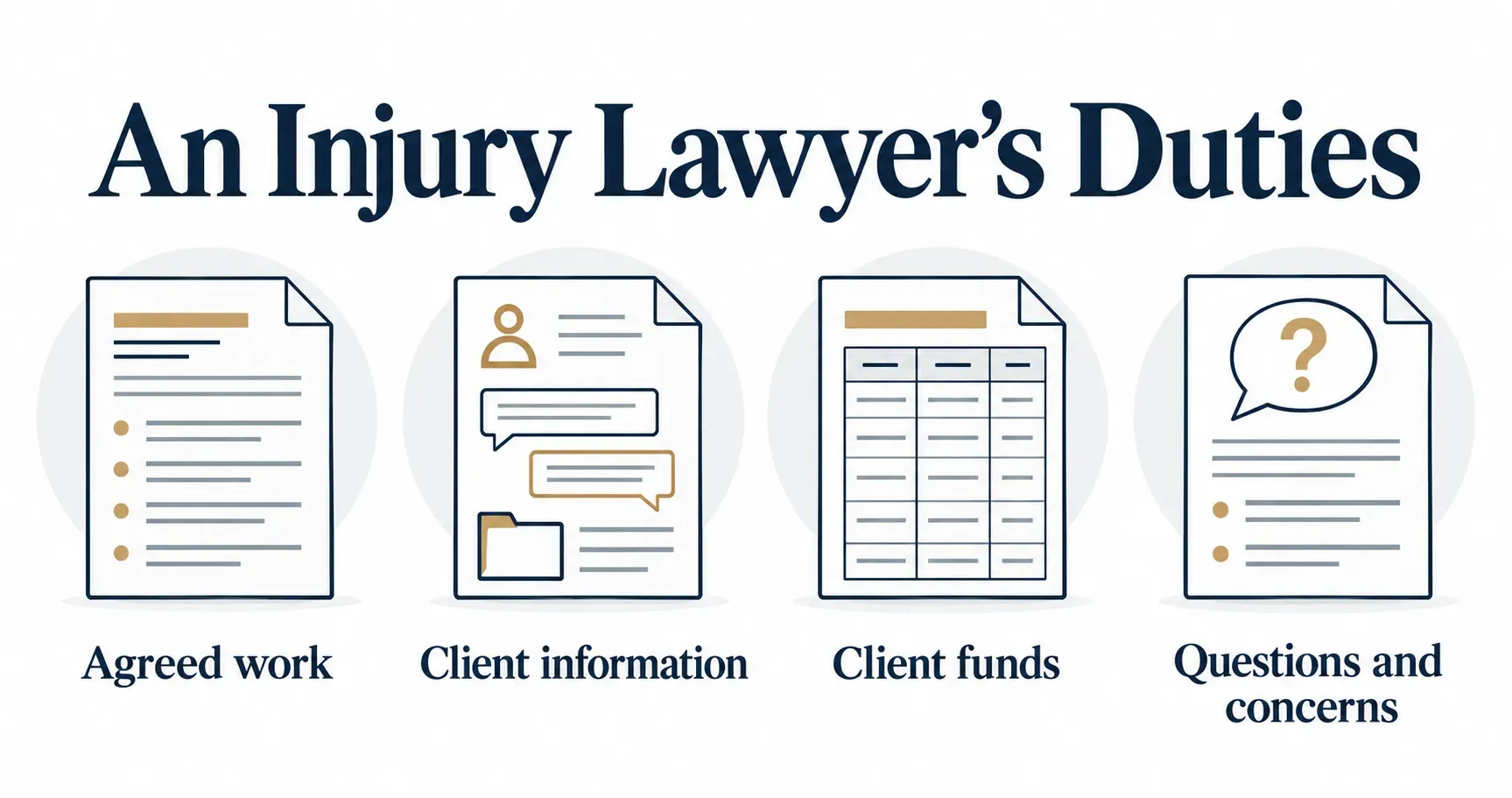
An injury lawyer’s professional duties concern the conduct of the representation: competent preparation, reasonable diligence, communication, independent judgment, protection of information and proper handling of money. Those duties apply within the governing rules and the work accepted. They do not promise a settlement, trial result or payment.
A useful way to examine a concern is to identify the duty, the work or decision involved and the records showing what happened. An unanswered status request, a disputed expense and a suspected misuse of funds raise different questions. Georgia’s professional rules and client assistance procedures provide distinct standards and review routes.
Identify the Client and the Accepted Work
The Georgia Rules of Professional Conduct govern lawyers’ professional obligations. Identify who the client is, which claims and stages the lawyer accepted and any agreed limits. A person paying a bill, helping a relative or referring a case does not become the client solely through that role.
Rule 1.2 permits a reasonable limit on representation with the client’s informed consent. A claim investigation, insurance negotiation, lawsuit, appeal and judgment collection can involve different work. Acceptance of one does not establish acceptance of all of them. A limit cannot be treated as permission to disregard duties that apply to the entrusted work.
For practical questions before retaining a lawyer, use the hiring and representation article. During an existing case, keep the agreement and any later changes available. If the work is unclear, ask your lawyer to identify the tasks accepted, excluded tasks and responsibility for approaching dates.
A consultation about possible representation can create duties under Rule 1.18 even if no engagement follows. Those prospective client duties depend on the circumstances and do not mean that every unsolicited message creates full representation. Confirm any accepted responsibility while keeping your own notices and dates.
- Accepted work
- Identify the client, task, stage and agreed limits.
- Professional standard
- Identify the rule and the conditions relevant to the conduct.
- Available record
- Keep the agreement, instruction, document and response.
- Unresolved question
- Ask what happened, what remains and who will address it.
Competence Requires Preparation for the Particular Work
Rule 1.1 requires the legal knowledge, skill, thoroughness and preparation reasonably necessary for competent representation. The relevant questions concern the legal issues, available facts, research and preparation the work needs. A professional title or confidence in an outcome does not establish that preparation.
When a lawyer knows or should know that a task exceeds the lawyer’s competence, the rule addresses associating a lawyer reasonably believed competent for that work. That does not mean every injury claim requires a particular specialist, medical expert or accident reconstruction professional. The need depends on the issues and proof.
Preparation can involve reviewing records, identifying disputed facts, checking applicable law and considering what additional evidence is needed. Ask what question a proposed investigation or outside professional would address and how its cost would be handled. A duty to prepare does not guarantee that every requested record exists, can be obtained or will be admitted in court.
Diligence Includes Attention to Entrusted Work and Dates
Rule 1.3 requires reasonable diligence and promptness in representing a client. A lawyer cannot willfully abandon or disregard entrusted work to the client’s detriment without just cause. The duty needs assessment against the work accepted and the circumstances; delay alone does not prove a violation.
Filing, notice, service, discovery and court response requirements may affect an injury case. Ask which dates your lawyer is handling and what information is needed from you. A pending negotiation, transfer request or professional complaint should not be assumed to extend a legal deadline.
After an adverse decision, clarify the status of the representation and the possibility of review before assuming that your lawyer will file an appeal. Appellate work and enforcement of a judgment may require separate arrangements. Ask for the decision, relevant dates and an express explanation of who is handling any further work.
Client Decisions and Professional Judgment Have Defined Roles
Under Rule 1.2, the client makes the civil settlement decision, and the lawyer consults with the client about the means of pursuing the representation. A lawyer’s recommendation to accept an offer is not the client’s acceptance. The client needs information sufficient to make the decision entrusted to the client.
The client’s objectives do not authorize a lawyer to assist crime or fraud, offer false evidence or disregard professional obligations. A lawyer may explain legal limits or decline an instruction that cannot lawfully be carried out. Disagreement about a tactic needs discussion of its purpose, alternatives and consequences.
When someone acts for a child, estate or another person, identify the person’s legal authority and any required approval before relying on instructions or a signature. Ask who can decide, what documentation establishes that authority and which decision needs additional review.
- Client decision
- The civil settlement decision belongs to the client under Rule 1.2.
- Professional judgment
- Your lawyer advises and consults about the means of pursuing the representation.
- Legal constraint
- Client instructions do not authorize crime, fraud or false evidence.
- Representative authority
- Confirm authority and any approval requirement before relying on instructions.
Communication Must Support Informed Decisions
Rule 1.4 addresses consultation, information and explanation. A lawyer must keep the client reasonably informed about the status of the work and respond promptly to reasonable requests for information. The explanation must be sufficient for informed decisions about the representation.
Communication is more than sending a result without context. An offer, court ruling or request for consent may require an explanation of its terms, options and consequences. Ask your lawyer to identify the document being discussed, what remains disputed and what instruction is needed from you.
Promptness is assessed in context; the rule does not prescribe an immediate reply or a fixed response interval in every case. If a complete response cannot be prompt, acknowledgment and an indication of when a response may be expected can be appropriate under the rule’s comments. Report an approaching date in the request itself.
- Identify the specific question and the case document it concerns.
- State any response date shown in the document.
- Ask who will provide the legal explanation and how to reach that person.
- Keep the request, acknowledgment and reply.
- Update contact information so your lawyer can reach you for instructions.
Confidentiality Has Conditions and Exceptions
Rule 1.6 concerns information gained in the professional relationship. It restricts disclosure, subject to informed consent, authority implied for the representation and exceptions under the rule or other applicable law. The duty can cover information beyond a single private conversation. Conditions and exceptions govern disclosure.
Ethical confidentiality and evidentiary attorney-client privilege are different protections. Privilege questions concern particular communications and the governing law. Sharing information with family, another adviser, an insurer or an outside participant can require review of the person’s role and the effect on protection.
Ask who may receive case information, how sensitive documents should be sent and how to report a mistaken disclosure. Reasonable safeguards depend on the information and circumstances. No general article can promise that every message, device or online inquiry is protected in the same way.
- Status information
- Keep the client reasonably informed about the accepted work.
- Decision explanation
- Provide enough explanation for informed client decisions.
- Confidentiality
- Apply Rule 1.6 with its conditions and exceptions.
- Privilege question
- Examine the particular communication and governing law.
Conflicts Can Restrict Representation
Rule 1.7 addresses a significant risk that a lawyer’s interests or duties to another person will materially and adversely affect representation. Clients injured in the same incident may have different positions on fault, available funds or settlement. A family relationship or shared objective does not eliminate the need to examine conflicts.
Where consent is permitted, the Georgia rule requires consultation, written information about material risks and reasonably available alternatives, an opportunity to consult an independent lawyer, and informed consent confirmed in writing. Some conflicts cannot be cured by consent. A signature alone does not make every joint representation permissible.
Provide the names of relevant people and organizations and tell your lawyer when interests or relationships change. Ask which client the lawyer represents and how a potential conflict will be addressed. Do not assume that a lawyer advising one person in an incident necessarily represents every other person involved.
Someone Else Paying Does Not Control the Legal Judgment
Rule 1.8(f) places conditions on compensation by someone other than the client, including informed consent, protection against interference with professional judgment or the client relationship and protection of client information under Rule 1.6. Payment or referral does not remove the lawyer’s obligations to the client.
Fees and Expenses Require Clear, Reasonable Terms
Rule 1.5 prohibits unreasonable fees and expenses. It addresses communicating the scope of representation and the basis or rate of the fee and expenses, preferably in writing, before or within a reasonable time after work begins, subject to the rule’s regular client provision. Changes in the basis or rate must be communicated.
A contingency fee agreement must be in writing and explain the calculation method, including applicable percentages at settlement, trial or appeal and how litigation and other expenses affect the calculation. Expenses deducted before the fee and expenses deducted after it produce different calculations. No universal percentage or promise of no costs follows from the word contingency.
The hiring article provides a detailed agreement checklist. For an existing concern, compare the charge with the written terms, later changes and the work performed. Request an explanation of the fee method and each expense. An unexplained total is not a complete accounting.
Client Money Requires Safekeeping and Accounting
Rule 1.15(I) requires client property and property of another person covered by the rule to be kept separate from a lawyer’s own property. When funds or property are received in which a client or another person has an interest, notification, delivery and accounting obligations can apply. The rule addresses prompt delivery of amounts a person is entitled to receive and a full accounting on request.
A settlement received by your lawyer is not automatically money available for immediate payment of the whole gross amount to the client. Fees, agreed expenses and legally recognized interests may need to be addressed. Ask when funds were received, the amount, the proposed deductions and the basis for any sum being held.
The rule addresses known interests supported by a statutory lien, final judgment or written agreement guaranteeing payment from funds held, with its stated qualifications. A demand from a creditor does not by itself prove an enforceable interest. The legal basis and any valid defense need examination.
When entitlement to a portion is disputed, the disputed portion must remain separate until the dispute is resolved, and amounts not in dispute are to be distributed promptly as the rule requires. A lawyer should not treat holding a disputed portion as permission to keep every amount indefinitely or decide a contested entitlement unilaterally.
- Receipt
- Identify funds received and provide the required notice.
- Accounting
- Explain the calculation and provide a full accounting on request.
- Disputed portion
- Keep disputed funds separate until the dispute is resolved.
- Undisputed amount
- Distribute amounts promptly as the rule requires.
- What amount was received, on what date and for which claim?
- What fee and expense calculation is proposed?
- Who claims an interest in funds, and what supports it?
- Which amount is disputed and which amount is undisputed?
- What accounting and supporting documents can be provided?
Truthful Advocacy Includes Duties to the Tribunal and Evidence
Rules 3.1 and 3.2 address proper claims and reasonable efforts to expedite litigation consistent with the client’s interests. Representation does not require filing every requested motion or using proceedings merely to harass. A position must have the basis the applicable rule requires, including any good faith argument for a change in law.
Rule 3.3 prohibits specified knowing false statements, false evidence and other failures of candor to a tribunal. It addresses known controlling adverse legal authority and remedial steps when material evidence is later known to be false. These duties can require action despite confidentiality obligations in the circumstances covered by the rule.
Rule 3.4 prohibits unlawful obstruction of access to evidence and unlawful alteration, destruction or concealment of material with potential evidentiary use. It prohibits falsifying evidence or assisting false testimony. A request to correct an error is different from altering evidence to create a misleading account.
Describe events accurately and provide relevant records, including unfavorable information. If you find an error in a statement or document, tell your lawyer and preserve the original. These rules do not mean every allegation is false, every uncertain memory is misconduct or every adverse fact must be disclosed in every context.
Delegation Requires Appropriate Supervision
Rules 5.1 and 5.3 address the responsibilities of law firm managers and direct supervisors for lawyers and nonlawyer assistants. They require reasonable efforts concerning compliance with professional obligations and can impose responsibility for ordered or knowingly ratified conduct, or failures to take remedial action in specified circumstances.
Delegation is not automatically improper. A staff member can help with records, scheduling or other tasks while legal work remains subject to applicable professional responsibilities. Ask who handles the legal question, who supervises delegated work and how an unresolved issue reaches the responsible lawyer. A staff error does not automatically establish that every person in a firm violated a rule.
Closing or Ending Representation Carries Further Duties
At the end of a contingency fee case, Rule 1.5 requires a written statement describing the outcome and, when there is a recovery, the remittance and method of calculation. Review the fee, expenses, applicable fee division and other deductions. The compensation questions article addresses offers, releases, repayment questions and possible net proceeds in more detail.
Under Rule 1.16, ending representation is subject to applicable law, professional rules and tribunal orders. A lawyer may be required to continue when ordered, despite a reason to withdraw. A request to change lawyers and completion of a withdrawal approved by a court are not necessarily the same event.
On termination, the rule requires reasonably practicable steps to protect the client’s interests. These can include notice, time to obtain another lawyer, surrender of papers and property to which the client is entitled and refund of an advance fee payment that has not been earned. The reference to unearned advance fees does not establish that every expense must be refunded.
Request the case status, relevant orders and dates, the file or property to which you are entitled and an accounting. Confirm who is handling any remaining response, appeal or collection issue. Ending representation does not itself extend a deadline or establish that a new lawyer has accepted the work.
- Status and dates
- Identify current orders, unresolved work and approaching dates.
- File and property
- Request papers and property to which the client is entitled.
- Financial account
- Review fees, expenses, funds held and any unearned advance fee.
- Authority to continue
- Check tribunal requirements and who accepts remaining work.
Choose the Correct Route for a Concern
Begin by identifying the conduct and the remedy you need. Ask for a response to a specific status, document, accounting or charge question when that is appropriate. If a legal deadline or possible loss is involved, obtain independent advice promptly; do not wait for an informal program or complaint to resolve the underlying case.
Communication and File Concerns
The State Bar’s Client Assistance Program offers informal assistance with certain problems between clients and lawyers, including communication or file concerns. It does not intervene as a lawyer in the case, give individual legal advice or decide a civil malpractice claim. Keep the requests and replies needed for a clear account of the problem.
Professional Conduct Complaints
The State Bar’s ethics and discipline information describes the professional grievance process. Discipline addresses compliance with professional obligations. Dissatisfaction with an outcome does not alone prove misconduct, and the existence of an ethics concern does not automatically establish a civil damages claim.
Fee Disputes
The State Bar’s fee arbitration information describes a separate process for eligible fee disputes. Binding arbitration requires both parties’ agreement, and jurisdiction and other conditions apply. It is not a forum for deciding legal malpractice. Check the current instructions for consent and eligibility; do not assume a lawyer must participate or that every financial dispute is eligible.
Suspected Dishonest Loss of Money
The Clients’ Security Fund concerns certain losses from dishonest appropriation of money or property. Eligibility and discretionary review apply. It is not malpractice insurance or a promise of reimbursement. Check current eligibility and requirements for supporting documents directly with the program.
Possible Civil Liability
A possible civil claim against a lawyer requires independent legal review of the conduct, causation, loss and applicable law. The professional rules are not intended to create an independent cause of action or a presumption of breach merely from a rule violation. The same conduct may raise separate civil questions. Do not assume that a grievance, fee process or fund application protects a civil filing date.
- Communication or file
- Consider the Client Assistance Program and its informal role.
- Professional conduct
- Review the State Bar grievance procedure.
- Fee disagreement
- Check fee arbitration consent and eligibility conditions.
- Dishonest financial loss
- Check Clients’ Security Fund eligibility and discretionary review.
- Civil loss claim
- Obtain independent advice about liability and filing dates.
Questions About Duties During an Injury Case
Does a disappointing result prove a lawyer breached a duty?
No single result answers that question. Review the accepted work, preparation, communication, decisions and governing rules. An insurer, judge or jury can reject a position despite proper professional conduct. A specific concern needs examination of what happened and what duty applied.
Can a lawyer accept a settlement without my decision?
Rule 1.2 assigns the civil settlement decision to the client. Discuss what authority was given, the offer and the instructions recorded. If a representative acts for someone else, have that person’s authority and any approval requirements checked.
Must all settlement money be paid to me immediately?
The funds rules distinguish amounts a person is entitled to receive, legally recognized interests and disputed amounts. Ask for notice of receipt, a calculation, the basis for any hold and an accounting. Disputed and undisputed portions require separate attention under the rule.
Will a Bar complaint change the court result or pay damages?
Do not treat a professional complaint as a substitute for an appeal, civil claim, fee process or fund application. Each route has its own purpose and conditions. Obtain advice about any underlying case or filing date while a concern is being reviewed.
Ask TT Attorney About the Work You Need
Contact TT Attorney about an injury claim and ask what work the firm may accept. Identify the claim, available documents and any approaching date. Confirm the accepted scope, communication and financial terms before relying on an arrangement. You can ask a question with the information you already have.
For practice information, see the personal injury page. An inquiry does not promise acceptance or a particular result. The duties discussed here are general Georgia professional standards; an individual concern requires review of the facts, agreement and applicable rules.