
Criminal charges in Georgia can proceed through different documents and court routes. A police report, arrest warrant, traffic citation, prosecutor’s accusation and grand jury indictment do different work. An arrest does not itself establish a conviction, and an indictment is not required in every case. Identify the paper, the court and the current stage before deciding what must happen.
The route depends on the alleged offense, governing law and case history. A report can prompt investigation without producing a prosecution. A case can involve a citation or a charging document without following every event in a report, arrest and grand jury sequence. An early court appearance can address release or probable cause without deciding guilt.
For a case involving Marietta or Cobb County, keep the complete papers, current orders and approaching dates together. Tell a lawyer about an arrest, a served application or an upcoming appearance promptly. Waiting for a complete investigation file does not establish that every court requirement can wait.

Identify the document that brought you to the case
Start with what you received. A report records information given to or collected by investigators. A warrant can authorize an arrest. A citation can allege a violation and direct a response. An accusation or indictment identifies charges through a particular prosecution route. A notice can set an appearance without replacing the underlying charging paper.
The document’s title is only part of the review. Keep its entire contents, signatures, filing information, attachments and any later amendment. The charge description on a booking record can differ from the formal count later filed in court. Read the current papers alongside the earlier record.
- Report
- Information about an alleged incident; it is not a judgment of guilt.
- Warrant or citation
- Identify the authority, alleged offense and required response.
- Accusation or indictment
- Identify the prosecutor or grand jury route and the counts alleged.
- Notice or order
- Identify the appearance, filing requirement or condition currently imposed.
Ask what has been filed with the court and obtain a copy. A conversation about an expected charge is different from a filed instrument. A case number on one paper does not prove that every later count, notice or order has been checked.

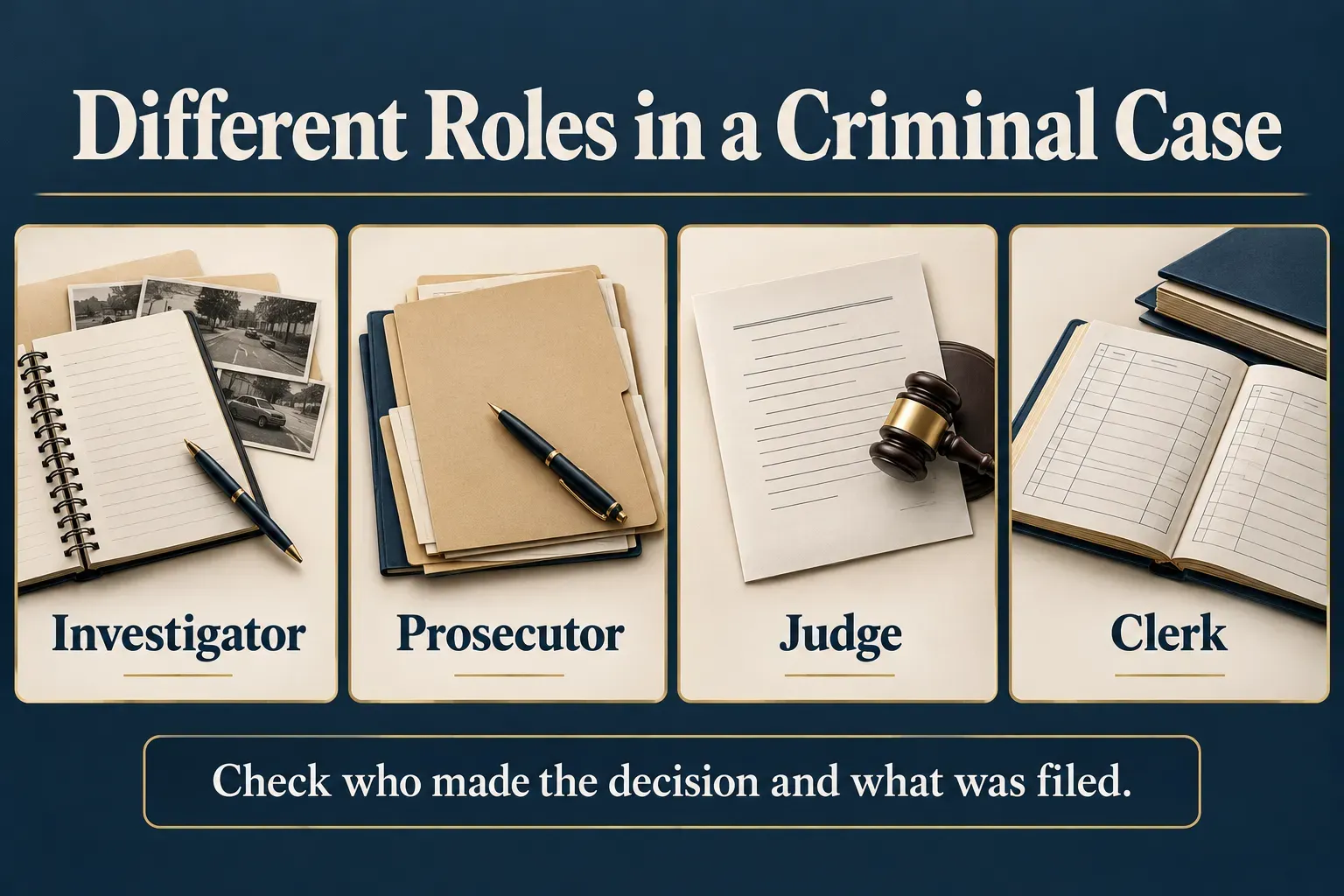
Separate the people who investigate, prosecute and decide
Law enforcement investigates reported or discovered conduct, gathers information and can seek warrants or make arrests under applicable law. The prosecutor reviews the case for prosecution. The Augusta Judicial Circuit’s official explanation describes those roles as independent and cooperative; it distinguishes investigation from the decision about charges to pursue.
A prosecutor can request further investigation, proceed on supported charges or decline prosecution. That review is not a promise that the arrest descriptions will remain unchanged. The prosecutor represents the government, not the accused person seeking advice about a defense.
Judges decide questions assigned to the court, such as a warrant request, release issue, motion or trial question within their authority. A grand jury has a separate charging function where that route applies. Clerks maintain the court’s filed records and notices; a clerk’s acceptance of a document does not decide guilt or supply legal advice.
For Cobb felony cases, the District Attorney’s office identifies its prosecution role. Other proceedings can involve a solicitor or municipal prosecutor. Use the court and prosecuting office identified in the papers instead of assuming every Georgia case belongs to the same office.
Keep an investigation separate from an arrest decision
An investigation can include witness accounts, records, recordings, photographs or physical evidence. The materials available can change as the investigation continues. Do not assume a brief report contains everything the government or defense may later review.
An arrest requires a lawful basis. A warrant and a warrantless arrest involve different legal requirements. A lawyer can review the alleged conduct, the information supporting the arrest and the procedure used. An accusation of wrongdoing in a report is not itself a substitute for that analysis.
If investigators contact you, identify the agency and explain the contact to a lawyer before deciding how to respond. Ask how the right to remain silent and the right to legal advice apply in the setting. Do not treat informal reassurance as a court order ending a case or as confirmation that a lawyer is representing you.
Preserve messages and papers about the contact. Do not delete records or try to make different accounts match. Tell the lawyer about an upcoming interview, requested response or known warrant. The appropriate response depends on the situation; the absence of an arrest does not establish that no legal work is needed.
Treat a civilian warrant application as its own proceeding
A private person’s request for an arrest warrant is different from a prosecutor filing an accusation. A warrant application hearing concerns the request before the judicial officer. It should not be described as a trial deciding every issue in a possible criminal prosecution.
Cobb County’s current Warrant Division instructions describe amended civilian application procedures effective July 1, 2026. The county requires personal service on the respondent and specifies the applicant’s responsibility for arranging service through an authorized person. HB 1131 amended the relevant warrant provisions.
If you receive a hearing notice, keep the application, service papers and any attachments. Confirm the named court, date, place and purpose. Do not ignore it because it came from a civilian application or assume the requested warrant has already been granted.
Discuss any contact restriction, related case or conflicting order with the lawyer. An applicant, respondent and witness can have different roles. This article addresses the accused person’s filing process; a person seeking to report a crime should use the responsible agency’s instructions rather than treat this explanation as a warrant application form.
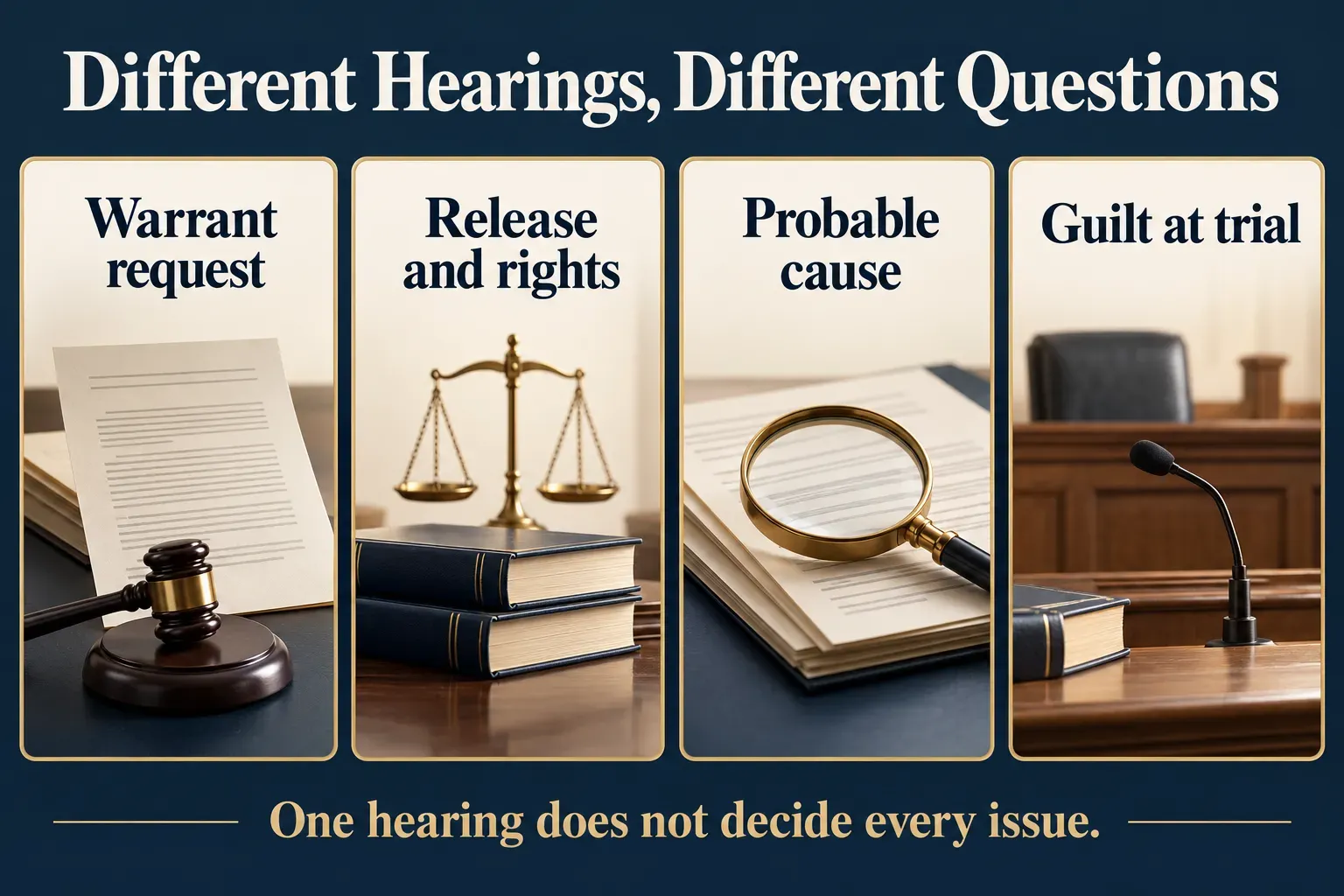
Distinguish an initial appearance from a commitment hearing
Georgia’s current Superior Court Rules distinguish the initial appearance, commitment hearing and later arraignment. Rule 26.1 states a general initial appearance requirement no later than 48 hours after a warrantless arrest or 72 hours after an arrest with a warrant, unless bond has been made in the meantime. A lawyer must assess the applicable rule and case circumstances.
The initial appearance addresses charges, rights, representation and release questions within the judicial officer’s authority. The Fulton County court explanation distinguishes that hearing from a trial on the merits. Do not use another county’s published hearing location or calendar as the instruction for a Cobb case.
A commitment hearing, often called a preliminary hearing, concerns probable cause for the case to proceed. The Georgia courts’ hearing descriptions identify that purpose separately from a warrant application and initial appearance. A probable cause decision is not a finding of guilt beyond a reasonable doubt.
The availability of a commitment hearing depends on procedural history, including release, waiver and charging developments. Ask what right remains before signing a waiver. Do not assume every defendant receives a separate hearing or that the absence of one automatically ends a prosecution.
- Warrant application
- Is the court considering a request for an arrest warrant?
- Initial appearance
- What rights, representation and release questions are being addressed?
- Commitment hearing
- What probable cause question is before the court?
- Trial
- What charges must the prosecution prove under the trial standard?
Read an accusation as a formal charging instrument
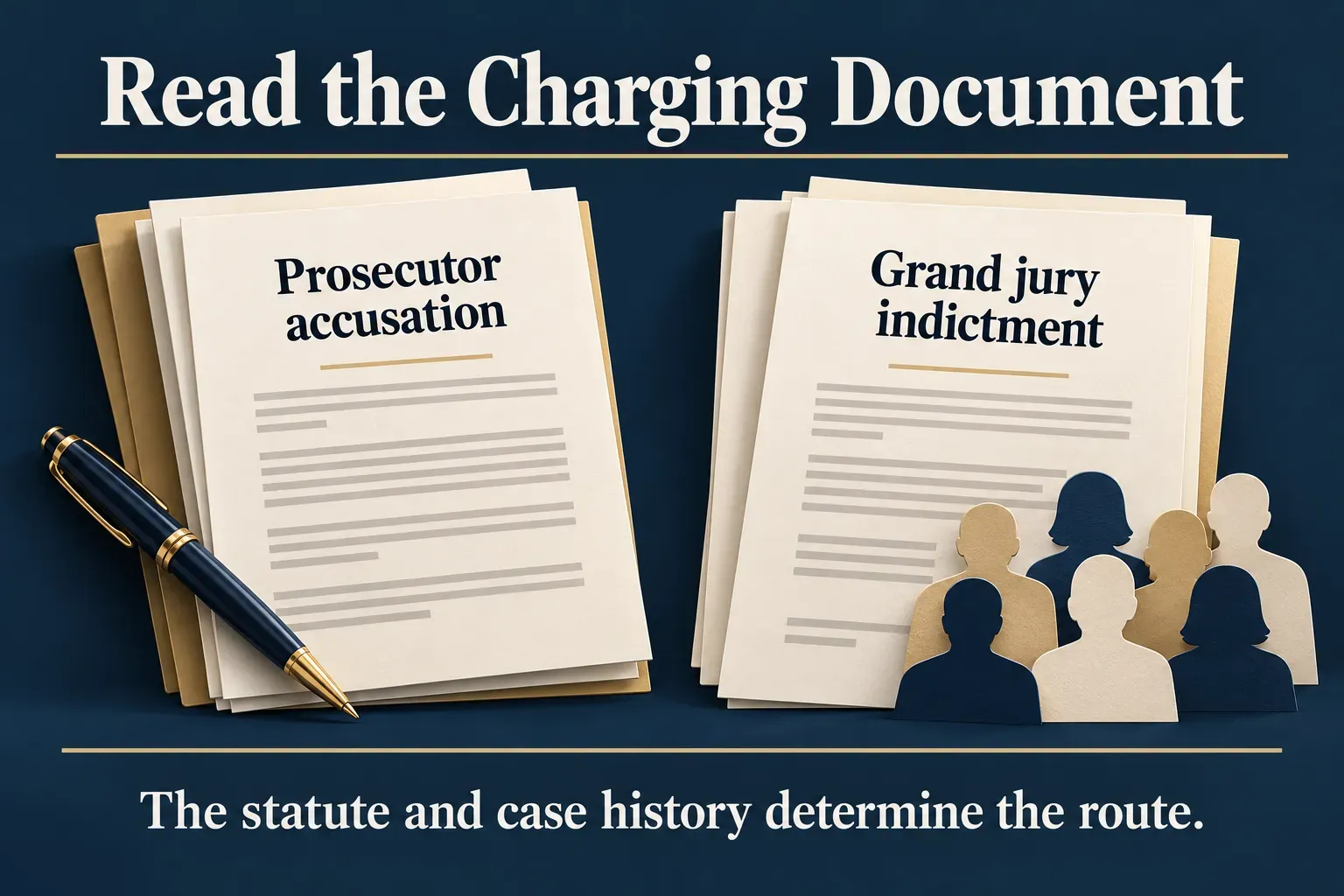
An accusation is a formal charging document prepared through the prosecution route authorized by law. It is not merely someone using the word accuse in a conversation. Read the charged offense, count, alleged facts, cited provision and court information on the complete document.
In its final State v. Riley opinion, the Supreme Court of Georgia distinguishes accusations brought by prosecutors from indictments brought by grand juries. The opinion explains that Georgia recognizes different charging forms with different statutory requirements. The correct form is a legal question, not a choice based only on how serious a charge sounds.
Misdemeanor prosecution can proceed by accusation. Some traffic cases can use a uniform traffic citation under the applicable law. The Georgia Department of Driver Services publishes that citation form, which is called a citation, summons and accusation. Do not conclude that every ticket is a civil fine or that every traffic case needs a separate grand jury indictment.
Keep an amended accusation with the earlier version. Mark the differences for the lawyer without changing either document. A later count or changed allegation can require a different response from the one discussed before the amendment.
Check the conditions for a felony accusation
Not every felony must proceed through a grand jury. O.C.G.A. §§ 17-7-70 and 17-7-70.1 provide distinct accusation routes with conditions. The official 2025 criminal procedure supplement contains the relevant provisions; the specific offense and procedural history must be checked against current law.
For the offenses listed in § 17-7-70.1, the statute addresses a probable cause finding at a commitment hearing or waiver of that hearing. It includes designated theft, fraud, confinement, firearm possession and controlled substance provisions. Those are statutory references, not permission to group every offense bearing one of those names into the same route.
The statute has limits concerning prior grand jury evidence, investigation or a returned no bill. Separate guilty plea and waiver provisions have their own conditions, including exclusions for offenses punishable by death or life imprisonment under § 17-7-70. Do not assume a signature on a generic waiver authorizes every accusation or relinquishes only one right.
Ask the lawyer to identify the applicable provision and explain the proposed waiver, court procedure and consequences before deciding. An older internet account can omit an amendment or a provision that has expired. A proposed bill is not current law merely because its summary appears in a search result.
Know what a grand jury indictment establishes
A grand jury considers the charging question assigned to it. An indictment alleges offenses; it does not convict the accused person. The official Georgia prosecutor explanation of grand jury review describes a decision about sufficient evidence to move forward with an indictment, separate from the trial determination of guilt.
Read the indictment for each count, the alleged conduct, dates and county, and the cited law. Keep the filed copy and any later version. The arrest description is not necessarily the entire set of allegations the prosecutor presents for charging review.
Do not assume the accused person and defense lawyer participate in a grand jury proceeding as they would in a trial. Particular statutory participation rights require separate legal review. A witness subpoena or notice concerning grand jury testimony should be discussed promptly with a lawyer who accepts that work.
If a no bill or other charging decision is reported, obtain the written record and ask what it means for each allegation and any release condition. Do not infer a permanent bar to every future proceeding or permission to stop complying with an order from an informal description of the result.
Confirm the court, case number and filed status
The county, court and stage must be identified together. Georgia has different trial courts with different powers. A city name, arrest location or felony label does not independently tell you where every initial hearing and later filing belongs. Use the notice and charging paper, and resolve inconsistent information before an appearance.
The Cobb Superior Court Clerk’s court information describes the superior court’s felony trial role. That does not turn every earlier magistrate appearance into a superior court trial. A municipal allegation, state law case, federal prosecution or juvenile proceeding can require a different analysis.
- Identity
- Named court, case number and the person identified in the papers.
- Document
- Filed charging paper, count list and any later replacement or amendment.
- Event
- Alleged offense date, arrest date, filing entry and scheduled appearance.
- Confirmation
- Current notice, court order, docket information and the person checking them.
A public search can help locate information, but a missing result does not prove no warrant, filing or restricted record exists. Ask the named court or lawyer about the particular record and keep copies of the response. Avoid sending sensitive case details to a commercial directory that only resembles an official court site.

Prepare for arraignment and the requirements that follow
Arraignment concerns notice of the charges and the plea. It is different from the initial appearance after arrest. Formal arraignment can be waived under the applicable procedure; a lawyer should explain the effect before a defendant relies on a waiver instead of attending.
Rules 30 and 31 of the Superior Court Rules address arraignment and motions. They do not create one universal motion deadline for every court and every filing. Confirm the governing law, scheduling order and any approved change. A draft motion or requested extension is different from a filed document or granted order.
After charging, the case can involve evidence disclosure, legal motions, plea consideration or trial. Those are different tasks, and not every case reaches a trial. A guilty plea has consequences that require advice about the particular charge, rights and available choices. A plea discussion does not itself change a filed charge or court condition.
For the difference between the offense family and legal classification, see types of criminal charges in Georgia. This filing article addresses the route and papers rather than providing a punishment table for every offense.
Keep release conditions separate from the charging decision
Release from custody does not itself dismiss a charge. An accusation or indictment does not itself answer every bond question. Read the release order, reporting requirements, appearance duties and contact restrictions that apply to the current case.
Ask which judicial officer can address the particular bond request. Some release questions require a court with specific authority. The official Recorder’s Court explanation of early hearings distinguishes probable cause review and bond authority; its local procedures should not be copied into a Cobb calendar.
If conditions conflict with a practical need, raise the problem with the lawyer promptly. A request for permission to travel, contact someone or change reporting is not the same as a granted change. Keep written confirmation of any order and continue to distinguish the current instruction from an expected future decision.
Tell the lawyer about other pending cases, holds or supervision. A change in one proceeding does not establish that every other requirement has ended. The appropriate court must address the specific issue through the applicable procedure.
Ask about delays without assuming automatic dismissal
There is no single waiting period that answers every Georgia charging question. Prosecution limitation periods, custody and bond provisions, speedy trial rights, and court scheduling concern different legal issues. Their triggers, conditions and remedies are not interchangeable.
Give the lawyer a dated history of the alleged incident, arrest, release, filed papers, prior hearings and communications. Explain any time spent in custody and provide every version of the charge. Ask which rule applies to the concern and what action, if any, must be taken.
Do not treat silence, release, a missing online entry or an expected review date as a written dismissal. Keep checking notices through the accepted representation arrangement. A delay may require legal action without establishing that a charge has permanently ended.
A useful update identifies the present stage, outstanding document and responsible person. A promise that every case will be charged or dismissed within the same number of days can hide the precise question a lawyer needs to investigate.

Preserve evidence and discuss representation before acting
Keep original messages, recordings, photographs and documents without editing or deleting them. Make a list of potential records and witnesses for the lawyer. Explain contact restrictions before attempting to interview or communicate with a person connected to the case.
The lawyer can review the papers, available evidence, charging authority and procedural choices within the accepted work. That review does not guarantee dismissal, a reduced charge or a particular bond. It should identify the supported legal questions and the duties that need attention.
If payment is a concern, ask the court about appointment and the financial assessment process. The Georgia Public Defender Council provides information about that process. Applying does not itself establish that a lawyer has been appointed or accepted every proceeding.
- Papers
- Charging documents, orders, release terms and service records.
- Dates
- Approaching appearances and a dated history supported by records.
- Evidence
- Originals, possible sources and any restriction on contact.
- Responsibility
- Lawyer accepting the work, scope, fees and communication arrangements.
Tell the lawyer promptly about interpreter services, hearing assistance, mobility access or other accommodations you need. Confirm arrangements with the named court rather than assume an accommodation follows from sending a general inquiry.

Questions about filing criminal charges in Georgia
Must an arrest happen before charges are filed?
Do not assume every case has that sequence. The authorized charging route and the case history determine the process. Obtain the filed paper and ask what appearance or other response it requires, even if there has been no earlier arrest.
Does every felony require a grand jury indictment?
No. Georgia law permits accusation routes for qualifying cases, subject to statutory conditions. The offense and any waiver or earlier hearing must be checked. The label felony alone does not identify the required charging form.
Does an indictment prove guilt?
No. An indictment is a charging instrument. A trial determines guilt under the applicable proof standard, while a plea follows its own legal procedure. Keep the charging decision separate from the later judgment.
Is the initial appearance the same as arraignment?
No. They address different stages and questions. Read the notice and confirm the hearing’s purpose, required attendance and current representation. Do not assume a discussion at an early hearing has resolved the plea or trial issues.
Can the person who reported the incident drop the case?
That person’s preference does not itself dismiss a prosecution. The Gwinnett Solicitor’s official explanation distinguishes the prosecutor’s decision from a named victim’s request. Obtain the current filing or order, and do not disregard a subpoena or contact restriction based on a private agreement.
How can I confirm what was filed?
Keep the complete document and check the named court, case number, counts and filing information. Ask the court or accepted lawyer about a missing or amended paper. An incomplete internet search is not proof that no proceeding exists.
Does a charging delay mean the case is dismissed?
Not automatically. A delay can raise different questions about custody, prosecution timing or trial rights. Give the lawyer the documented dates and ask which rule and remedy apply. Obtain written confirmation of any disposition.
What should I bring when asking a lawyer for help?
Bring the papers and notices you have, current release or protective orders, approaching dates and a list of possible evidence. Identify anything missing. Confirm who accepts the work before assuming an inquiry includes filing, court attendance or a separate proceeding.
Discuss the papers and approaching dates
Call 770-240-1014 to ask if TT Attorney accepts the work you need. State the named court, document received and approaching dates. Have the papers available if you can and explain an urgent release, service or appearance question promptly.
The firm’s criminal defense page provides its service information. Confirm the responsible lawyer, scope, fees and communication arrangements. An inquiry does not itself create an engagement to file a document, appear in court or resolve another agency’s requirements.